Showing posts with label recent readings. Show all posts

Wednesday, July 10, 2013

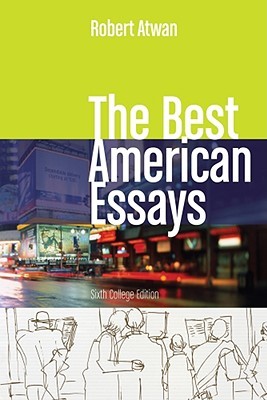
Recent Reading - The Best American Essays

A coworker recommended The Best American Essays, compiled by Robert Atwan, to me.  I had a great time reading it.


  1. The essay is a distinct style.  The essay is nonfiction, yet all these essays had stylistic elements reminiscent of some of my favorite fiction books. Some were even poetic.
  2. This particular version is meant for studying.  It includes questions to consider after each work, and has a huge intro featuring past editors opining on the essential qualities of a "best" essay.
  3. There are some solid writers and writing here. Joyce Carol Oates, David Sedaris, and Michael Lewis, among others.
  4. There is amazing content. You get pieces where the controversy the writing will incite makes the book feel heavier in your hands.  You get passionate points of view that propel you to cheer on the author's cause, at least for the moment.


There are thousands of essay writing contests.  I'll try my hand at a couple before the year is over.  I talked about writing essays vs. writing fiction in my interview with Eric LeMay.

I'm still undecided which is a better strategy for a competitive writer - diversification (trying many styles, genres, etc.) or specification.  In other words, is it better to be a master at one thing, or competent in several? It may be a little more complicated than that because the various forms of writing are not mutually exclusive.  Learning to juggle will not help you grow better tomatoes.  However, writing flash/micro fiction could help you write a concise essay.  And lastly, writing is writing.  Certain things (sentence formation, cutting passive voice, vocabulary, etc.) transcend genre.   What do you think?

Back to the essays, I'll cover some of my favorites from this collection:

Wednesday, May 15, 2013

Recent Reading - 50 Great Short Stories

As a student of the craft, it pays to see what the legends of the past have done. Originally published in 1952, 50 Great short stories includes literary heavyweights like Hemingway, Poe, Salinger, Joyce, O. Henry and more.

I've highlighted my favorite stories from the bunch and why I think they were selected to be a part of this anthology.

Tuesday, February 12, 2013

Recent Readings - Getting Religious

In my last recent readings post, I wrote about Geek Love.

Since then my next reads were:
1. A Reason For God - a nonfiction book advocating Evangelical Christianity
2. Why I Became an Atheist - also nonfiction, the antithesis to the prior work
3. The Life of Pi

This series ended up to be quite the harmonious medley. Geek Love told the harrowing tale of the potential self-destructive horror of cults.  The two nonfiction pieces were rich in spiritual/mental brain food, and were equally inspiring (more on that later).  The Life of Pi was my anchor and it brought everything together as it presented religion as rich, colorful, and beautiful part of life.

Back to the nonfiction pieces.  I had a little writer's epiphany.

NonFiction can strengthen Fiction

I'm sure there have been articles on this.  In this series however, there are arguments layered in the fiction pieces that are presented in much more depth and rigor in the nonfiction.  I think that if in a piece of writing you are going to explore a controversial issue, you want your character's point of view to be credible. Being well versed in the current debate, whatever that may be, and what the opposition may argue, will help add rich, substantive and controversial content to your tale.

Other books that do this well that come to the top of my head:
State of Fear by Michael Chrichton
Atlas Shrugged by Ayn Rand
The Scarlet Letter by Nathaniel Hawthorne

Monday, December 3, 2012

Recent Reading: Finding Inspiration in Geek Love

Geek Love by Katherine Dunn is in may ways the type of book I want to write.  It addresses some fundamental questions on the nature of humanity in a creative and compelling (although at times morbid and disturbing) way. 

I'll sumamrize the narrative using quotes from the work itself, adding my own emphasis.  The story is told by Olympia, the albino hunchback daughter of Al and Lily Binewski.

The set up:

“Al was a standard issue Yankee, set on self-determination and independence, but in that crisis his core genius revealed itself. He decided to breed his own freak show.”
“As she [Lily] often said “What greater gift could you offer your children than an inherent ability to earn a living just by being themselves?””
“My mother developed a complex dependency on various drugs during this process, but she didn’t mind.  Relying on Pap’s ingenuity to keep her supplied, Lily seemed to view her addiction as a minor by-product of their creative collaboration.”
Intrigued about what is going to happen with this family? Well, the children seem to embrace their genetics in various degrees of enthusiasm.  The most assertive of them all is Arturo, or Arty, who was born with fleshy fins instead of hands and feet.  He is a very interesting character, and the path he takes carries the novel's tension, to thepoint where he forms his own cult.  Below is some insight on his journey.

The development of Arty:

“Hey, nit qaut! These [horror stories] are written by norms to scare norms.  And do you know what monsters and demons and rancid spirits are? Us, that’s what. You and me.  We are the things that come to the norms in nightmares.  The thing that lurks in the bell tower and bites out the throats of the choirboys – that’s you.  And the thing in the closet that makes the babies scream in the dark before it sucks their last breath – that’s me. …These books teach me a lot.  They don’t scare me because they’re about me. Turn the page.”
+
“That’s my curse.  I’m a freak but not much of a freak.  I’m like you, f*d up without being special.”
+
Arturism was founded, wrote Sanderson, “on the greed and spite of a transcendental maggot named Arturo Bineswski, who used his own genetic defects and the weakness of the unemployed and illiterate to create an insanely self-destructive following that fed his maniacal egos”…
“Within days, Arturo, the clever boy, had turned the attack to his own purposes…proclaiming that he was, indeed, the Transcendental maggot, and that his power to thrive in the decaying frenzy of the planet was available to all those who were willing to accept it.”

The Side Story:

Olympia often struggles with family dynamics.  Her daughter, Miranda, is unaware of her existence. Yet, Olympia still checks in on her.  Her daughter was born with a tail, and she uses it as a source of income, much like the family she doesn't know about.  However there is a person who has offered to remove that.   Miranda asks if she's wrong to like her tail...

Miranda: “You must have wished a million times to be normal.”

Olympia: “No”

Miranda: “No?”

Olympia: “I wish I had two heads. Or that I was invisible. I’ve wished for a fish’s tail instead of legs. I’ve wished to be more special.”


Philosophy:

As you can tell, there is anteresting paradigm for this novel.  the normalcy of unnormalcy if you will.  The author like to turn the concepts of love, beauty, and social norms on their head.  Here are a few more samples that I enjoyed.

On the concept of the innocence of childhood (or in the case the innocence of adulthood)

“It is, I suppose, the common grief of children at having to protect their parents from reality. It is bitter for the young to see what awful innocence adults grow into, that terrible vulnerability that must be sheltered from the rodent mire of childhood.

Can we blame the child for resenting the fantasy of largeness? Big, soft arms and deep voices in the dark saying “Tell Papa, tell Mama, and we’ll make it right” The child, screaming for refuge, senses how feeble a shelter the twig hut of grown-up awareness is. They claim strength, these parents, and complete sanctuary. The weeping earth itself knows how desperate the child’s need for exactly that sanctuary. How deep and sticky is the darkness of childhood, how rigid the blades of infant evil, which is unadulterated, unrestrained by the convenient cushions of age and its civilizing anesthesia.

Grownups can deal with scraped knees, dropped ice-cream cones, and lost dollies, but if they suspected the real reasons we cry they would fling us out of their arms in horrified revulsion. Yet we are small and terrified as we are terrifying in our ferocious appetites.

We need that warm adult stupidity. Even knowing the illusion, we cry and hide in their laps, speaking only of defiled lollipops or lost bears, and getting a lollipop or toy bear’s worth of comfort. We make do with it rather than face alone the cavernous reaches of our skulls for which there is no remedy, no safety, no comfort at all. We survive until, by sheer stamina, we escape into the dim innocence of our own adulthood and its forgetfulness.”

+


On love - from one of the Siamese twins.

“He was normal with a big N.  That was what I loved.  But, when the look in his eye changed, I realized, if there’s one thing a healthy, beautiful, utterly normal boy does not do, it’s fall in love with half a pair of Siamese twins.
+

On greatness - a reporter to Arturo

“Is elephant gas great?  Is it great in the pain that it causes the elephant? Or in the relief, it affords when expressed? Or perhaps it is only great if it is ignited on farting and the resulting explosion is used to power a turbine? Is an elephant fart great in and of itself? Or only in its effect?”
+

On Social Conventions

"She talks. People talk easily to me.  They think a bald albino hunchback dwarf can’t hide anything.  My worst is all out in the open….Just being visible is my biggest confession, so they try to set me at ease by revealing our equality, by dragging out their less apparent deformities.”

Great Language:

A hallmark of most great works of literature are some choice moments when words begin to make music.  Dunn pulls of it off several times.  Here are my favorites.
“You girls look better now. Less like a demon crew and more like hung-over angels.”
"She tears me up.  I sit here laughing at her.  She is a galumphing dugong, an elvish ox, a sentimental rhino.”
"There are parts of Texas where a fly lives ten thousand years and a man can’t die soon enough.”


Saturday, July 21, 2012

Recent Readings- Staying Local

Picked up a couple more local fiction books.


Humorous mystery writer Brian Landon also happens to work with me.  not only do I get to meet the author, he's given me some advice, too!  Read A Grand Old Murder and The Case of The Unnecesary Sequel.  It's a lot of fun to read something where the action takes place on streets you are familiar with.


http://brianlandon.com/


I also read Minnesota Cold by Cynthia Kraack.  I had the chance to meet her, but screwed up.  Hopefully I'll get another opportunity.  She writes speculative fiction, which is a genre I am very much interested in.


http://www.amazon.com/Minnesota-Cold-Cynthia-Kraack/dp/0878393234

Wednesday, April 25, 2012

Recent Readings - April 2012 - Supporting Local Authors

This month, I wanted to take a look at some of the writers in my backyard.  I think that when it comes to reading, aspiring writers may be tempted to look at the classics and the greats.  But truth be told, there are thousands of books on the library shelves between Dickens and Thoreau.   It's way more likely that your success will look more like these shelf fillers than the breakout sensations of JK Rowling or Suzanne Collins. So, from a looking at your own future standpoint, local authors are great ways to see what's immediately within your reach.

There's some other benefits in reading local writers.
1. They are more accessible.  I have been able to shake hands and get these books signed by the writers.
2. I think it's good karma. telling an author you bought their book is a great compliment.  Maybe one they will return one day.
3. It's enjoyable.  When you read about a place you've been or something you know about, you feel like your part of an inside job.

So without further blabbering, here were the books I took on this month.


A Face of Courage: The Tommy Watson Story - How Did He Survive? . By Tommy Watson. A memoir type account of growing up in the slums of Colorado and overcoming the challenges that presented. I found some great insights about the mentality and perspectives of a troubled youth a collegiate athlete and a black man.


Basket Cases.  By Derek Wolden -  A non-fiction work designed to educate parents and coaches involved in youth athletics, specifically basketball.  There's some great humor here, as Derek approaches a subject that needs to be confronted.


Desert High.  By Doug Van Pelt.  This one isn't a Minnesota author, but I went to the same school in California., and have been a subscriber to HM Magazine for years. The story is about a guy who goes back in time to alter the outcome of a controversial football game.

Monday, March 12, 2012

Recent Readings - March 2012

Here's a new feature.  Scour the library and internet for writing advice and chances are you will see two common themes emerge.

1. Write a lot.
2. Read a lot.

I've shown a lot of how I practice #1, but now I thought I'd add some of what I've looked at per number 2.  If you have any reading recommendations, let me know!

FICTION-

The Portable James Joyce-  A lot of writers/editors list Joyce as an example of an author's author.  I picked up this anthology to try to see what the hype was all about.  Maybe it was my mood, or high expectations, but I just couldn't get into it.  I might revisit Joyce later, but for now I'm calling him overrated. (Yikes!)

The Complete Short Stories of Ernest Hemingway -  In contrast to Joyce, I found Hemingway thoroughly enjoyable.  His style is so terse and matter of fact, yet now and then he puts in some choice language to add note of brilliance.  I love it when writing excites me, and his definitely does.  I'll probably buy this thing and study it and then likely imitate it.

WRITING ADVICE-

The forest for the trees : an editor's advice to writers - Kind and gentle, but a touch lengthy for amount of valuable information gleaned from it.  I found the first half where Lerner categorizes the various types of writers to be almost completely useless, but the second half is definitely worth reading.

Getting started as a freelance writer  - This thing should be a Bible for anyone wanting to make a career of writing.   There is a wealth of knowledge, presented in a matter of fact type of way.  It's a fantastic reference manual.